Industry Whitepaper: Precision Surgical Curettes Procurement & Manufacturing Benchmarks for the German Healthcare Sector
The German medical device ecosystem represents one of the most stringent regulatory and qualitative landscapes globally. Mediated by the European Medical Device Regulation (EU MDR 2017/745) and supervised by the Federal Institute for Drugs and Medical Devices (BfArM), healthcare purchasing managers (Einkaufsleiter) and medical device distributors across Germany demand absolute compliance, structural metallurgy consistency, and verified reprocessing safety. As a specialized OEM/ODM manufacturer headquartered in Sialkot—the international capital of medical forging—Rigor Instruments bridges the gap between high-precision hand craftsmanship and ultra-scalable B2B manufacturing.
Surgical curettes—spanning ear/adenoid curettes, orthopedic micro-curettes, spinal scraping tools, and gynecological scoops—are subjected to intense mechanical stress, delicate soft-tissue manipulation, and repeated high-temperature autoclave cycles. Providing true Information Gain for procurement teams requires dissecting raw steel selection, tip sharpness retention, ergonomics, and seamless OEM/ODM branding flexibility.
German Stainless Steel Forging
Forged strictly from high-grade AISI 410, 420, and 316L German and Japanese stainless steel alloys (DIN EN 10088-3), guaranteeing superior corrosion resistance, high tensile strength, and edge sharpness longevity across 100+ sterilization cycles.
EU MDR 2017/745 Readiness
Complete technical documentation suites, risk management protocols (ISO 14971), unique device identification (UDI) laser marking, and biocompatibility verification (ISO 10993) ready for seamless integration into EUDAMED databases.
Bespoke OEM/ODM Customization
Tailor-made cup angles (0°, 15°, 45°, 90°), reverse/forward cut configurations, knurled ergonomic handles, custom lumen diameter for suction curettes, and OEM laser-engraved catalog references.
Localized Application Scenarios across German Healthcare Facilities
German healthcare delivery relies heavily on specialized hospital departments (Kliniken), University Medical Centers (Universitätsklinika), and Ambulatory Surgical Centers (Medizinische Versorgungszentren - MVZ). Each institutional setting demands dedicated curette specifications tailored to exact surgical protocols:
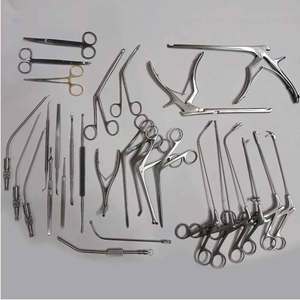
- ENT & Rhinology (HNO-Heilkunde): In functional endoscopic sinus surgery (FESS) and adenoidectomies, micro-adenoid curettes (such as Barnhill or Beckmann variants) demand precise cup sharpness to achieve full tissue excision without causing mucosal tear or periosteal damage. Suction curettes with integrated aspiration tubes ensure clean surgical fields during endoscopic sinus clearance.
- Neurosurgery & Minimal Invasive Spine Surgery (UBE & Micro-Discectomy): Micro-curettes utilized in Unilateral Biportal Endoscopy (UBE) and lumbar micro-discectomy require ultra-slender shafts (1.5mm to 3.0mm) crafted from hardened AISI 420 steel. These allow neurosurgeons to clear osteophytes and ligamentum flavum remnants near spinal nerve roots under 4K endoscopic visualization without flex distortion.
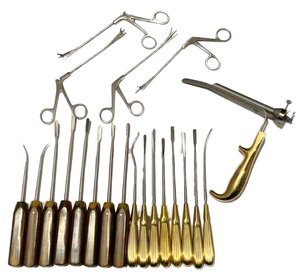
- Orthopedic & Trauma Surgery (Unfallchirurgie): Bone curettes (Volkmann, Brun, or Spratt designs) applied in bone grafting and subchondral scraping require high torque resistance and anti-glare satin finishes. German operating theaters prefer glare-free matte surfaces under high-intensity LED surgical illuminators.
- Plastic & Cosmetic Surgery (Plastische und Ästhetische Chirurgie): Specialized endoscopic facelift sets utilize subperiosteal dissectors and facial curettes with polished smooth edges to elevate delicate facial fascial planes while preserving nerve pathways.
- Gynaecology & Reproductive Medicine: Sharp and blunt uterine curettes engineered with malleable shunts allow precise scraping in diagnostic and therapeutic procedures while maintaining tactile feedback for the surgeon.
German Market Macro-Trends & Strategic Supply Chain Diversification
The German medical device purchasing landscape is currently undergoing a structural transformation driven by three core macro-trends:
1. Escalating Cost Pressure on Hospital Purchasing Budgets (DRG System Optimization): Under the German Diagnosis-Related Groups (G-DRG) system, hospitals face tight fixed-reimbursement constraints. Traditional European brand-name surgical curettes often carry excessive brand markup. German buyers are actively establishing direct factory relationships with validated OEM/ODM manufacturers like Rigor Instruments to lower procurement costs by 30% to 50% without compromising stainless steel metallurgy or ISO certification.
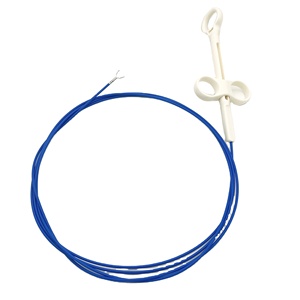
2. Balance Between Reusable (Mehrweg) & Single-Use (Einweg) Modalities: While environmental sustainability mandates favor sterilizable reusable instruments made of high-grade German stainless steel, high-turnover procedures (such as gastrointestinal endoscopic hemoclip placement or rapid foreign body retrieval) are shifting toward single-use sterile tools. Rigor Instruments manufactures both ultra-durable reusable curettes capable of surviving 100+ autoclave passes (at 134°C per DIN EN 285) and cost-optimized sterile single-use endoscopic instruments.
3. Resilience against Supply Chain Disruptions: Recent global disruptions highlighted the vulnerability of single-source supply chains. European medical distributors are building strategic dual-sourcing partnerships with accredited manufacturers in Sialkot who maintain ready inventories of raw AISI steel, modern CNC grinding centers, and certified passivation channels.