DeBakey Atraumatic Peripheral Vascular Clamp
- Overall Length: 160 mm – 240 mm
- Jaw Configuration: Straight / 45° Curved
- Serration: 1x2 Longitudinal Teeth
- Steel: German Stainless Steel DIN 1.4021
- Application: Femoral, Popliteal & Carotid Occlusion
An authoritative technical reference for healthcare procurement officers, hospital purchasing committees, and medical device distributors worldwide. Written by Rigor Instruments' senior surgical engineering and quality assurance team.
DeBakey Clamps represent one of the most critical breakthroughs in 20th-century cardiovascular surgery. Developed by pioneering heart surgeon Dr. Michael E. DeBakey, these specialized vascular occlusion instruments were designed to overcome a catastrophic limitation of traditional hemostatic forceps: crush injury to delicate arterial walls during temporary vascular clamping. When clamping major arteries—such as the abdominal aorta, carotid arteries, femoral vessels, or iliac branches—conventional cross-serrated or transverse-jaw clamps induce local mechanical crush trauma, causing severe intimal tearing, arterial plaque disruption, and secondary thrombosis.
The distinctive feature of genuine DeBakey Clamps lies in their proprietary longitudinal atraumatic serrations. The jaw profile incorporates interlocking parallel ribs—typically arranged in 1x2 or 2x3 longitudinal tooth configurations. Rather than pinching or crushing the vessel wall, the rounded longitudinal teeth gently nest into the vascular adventitia and media without penetrating the endothelial lining. This distributes clamping pressure uniformly across the entire length of the jaw, securing total vascular occlusion while preserving the structural integrity of the vessel.
Under microscopic stress analysis, standard transverse serrations apply localized shear vectors directly perpendicular to blood vessel fibers, frequently causing elastic fiber fracture. Conversely, DeBakey atraumatic longitudinal ridges create a wave-like gripping friction parallel to the vessel length. This minimizes peak pressure points (holding shear force below 1.5 N/mm²), eliminating intimal trauma while maintaining non-slip hemostasis under arterial pressures exceeding 200 mmHg.
At Rigor Instruments, located in Sialkot, Pakistan—the global epicenter of high-precision surgical instrument manufacturing—every DeBakey clamp is crafted from surgical-grade martensitic and austenitic stainless steels imported directly from certified mills in Germany (DIN 1.4021 / X20Cr13) and Japan (SUS 420J2). The metallurgical composition is strictly calibrated to satisfy international standards including ASTM F899 (Standard Specification for Wrought Stainless Steels for Surgical Instruments) and ISO 7153-1.
Key metallurgical properties required for premium DeBakey clamps include:
Global medical buyers, hospital procurement managers, and surgical distributors must select the appropriate DeBakey clamp configuration based on surgical specialty, vessel diameter, anatomical depth, and required clamping vector. Below is Rigor Instruments' recommended product lineup, designed to meet the rigorous standards of modern operating theaters worldwide.
To assist clinical procurement managers and biomedical engineers in drafting precise tender requirements, the matrix below details the engineering specifications of Rigor Instruments' core DeBakey Clamp series:
| Catalog Model | Clamp Name | Working Length | Jaw Profile & Angle | Tooth Spec | Recommended Clinical Indication |
|---|---|---|---|---|---|
| RI-DBC-001 | DeBakey Peripheral Clamp | 160 mm – 200 mm | Straight / 30° Light Curve | 1x2 Teeth (1.5mm width) | Femoral Artery Bypass, Carotid Endarterectomy |
| RI-DBC-002 | DeBakey-Satinsky Partial Occlusion | 220 mm – 260 mm | Double-Angled Contour Jaw | 2x3 Teeth (2.0mm width) | Vena Cava Side-Clamping, Atrial Anastomosis |
| RI-DBC-003 | DeBakey Coarctation Clamp | 220 mm – 280 mm | 90° Right Angle / Deep Curve | 2x3 Teeth (2.5mm width) | Thoracic Aortic Repair, Pediatric Coarctation |
| RI-DBC-004 | DeBakey-Derra Anastomosis Clamp | 170 mm – 190 mm | Curved Concave Jaw | 1x2 Micro Teeth (1.0mm) | Pediatric Cardiovascular & Small Vessel Anastomosis |
| RI-DBC-005 | DeBakey Multipurpose Clamp | 200 mm – 240 mm | S-Curve Angled at 60° | 1x2 Ribbed Teeth | Abdominal Vascular Grafting, Iliac Clamping |
| RI-DBC-006 | DeBakey Titanium Ultra-Light | 180 mm – 240 mm | Straight / Angled Variants | 1x2 Tungsten Coated | MRI-Compatible & Microsurgical Vascular Procedures |
Selecting an overseas surgical instrument manufacturer demands more than comparing catalog prices; it requires verifying authentic manufacturing provenance, quality management systems, metallurgical traceability, and compliance with stringent regulatory frameworks like EU MDR 2017/745 and US FDA 21 CFR Part 820. Rigor Instruments stands at the forefront of Pakistan's historic surgical instrument manufacturing hub in Sialkot, backed by over 40 years of specialized metallurgical craftsmanship and engineering excellence.
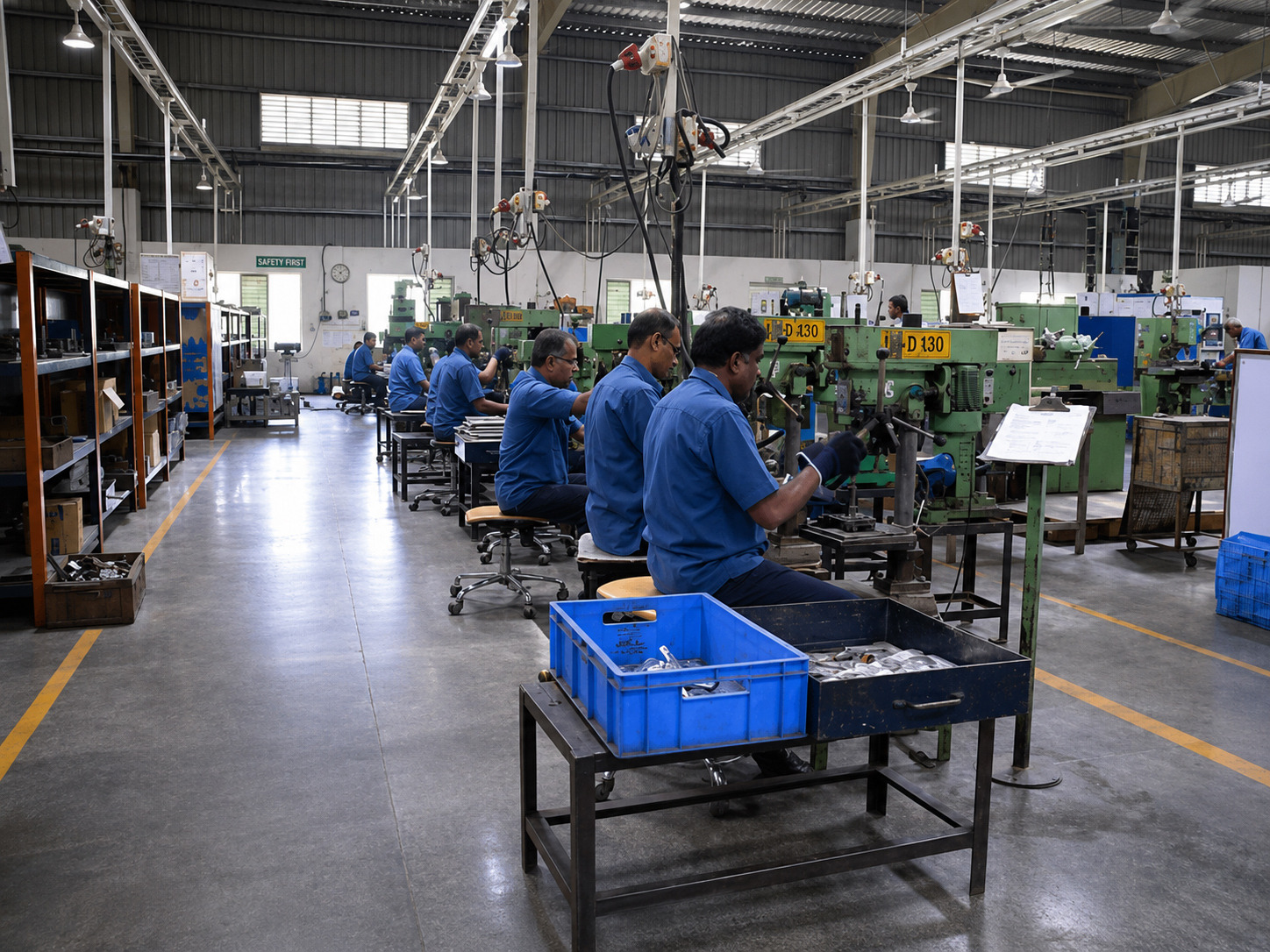
Sialkot produces over 70% of the world's hand-crafted surgical instruments. Rigor Instruments represents the peak of this heritage, blending generational forging wisdom with state-of-the-art 5-axis CNC machining, laser micromachining, and automated passivation lines.
Every DeBakey clamp produced in our facility is governed by rigorous ISO certifications and subject to batch-level quality audits, guaranteeing zero defect tolerance in critical surgical environments.
To ensure that every DeBakey Vascular Clamp provides consistent tactile feedback and reliable hemostasis, our production workflow adheres to six mandatory quality checkpoints:
The global cardiovascular surgical devices market is undergoing significant evolution driven by advances in minimally invasive surgery (MIS), hybrid operating rooms, digital inventory tracking, and stringent global medical device regulations. Procurement executives and healthcare buyers must anticipate these key structural trends when planning multi-year supply contracts for DeBakey Clamps.
While surgical-grade stainless steel remains the standard for general procedures, cardiovascular centers are increasingly specifying Grade 5 Titanium Alloy (Ti-6Al-4V) DeBakey clamps. Titanium offers a 40% reduction in weight, eliminating tissue drag during delicate aortic procedures, and provides 100% MRI compatibility for intraoperative imaging environments.
Under US FDA UDI (Unique Device Identification) and EU MDR regulations, all reusable surgical instruments require permanent, biocompatible machine-readable codes. Rigor Instruments integrates high-contrast fiber-laser QR/2D Matrix codes directly onto DeBakey clamp shanks, enabling automated hospital Central Sterile Services Department (CSSD) tracking.
As endovascular aneurysm repair (EVAR) and minimally invasive cardiac valve surgeries expand, demand is surging for DeBakey clamps with extended, slimline shanks (320 mm+) and ultra-low profile box joints. These specialized clamps allow surgeons to operate through restricted port sites while maintaining non-crushing vascular control.
Global medical supply brands are increasingly bypassing middle-tier broker networks in favor of direct contract manufacturing with ISO-certified Sialkot factories. Rigor Instruments offers full OEM/ODM services—including custom jaw curve design, custom laser engraving, private-label packaging, and tailored catalog numbers.
Below are detailed responses to the most frequent technical, regulatory, and commercial questions asked by hospital procurement departments, biomedical engineers, and international distributors when sourcing DeBakey Clamps.
DeBakey Serrations consist of rounded longitudinal parallel ribs (1x2 or 2x3 configurations) that run parallel to the vessel length, providing a smooth, continuous friction grip that avoids crushing tissue. Cooley Serrations, by contrast, feature tiny transverse pyramid-like teeth. While both are categorized as atraumatic compared to standard serrations, DeBakey teeth are widely preferred for fragile arterial walls (such as diseased aortas) because they distribute tension evenly along the longitudinal vascular fibers, significantly reducing the risk of intimal shear stress.
AISI 420 (DIN 1.4021 / X20Cr13) is a high-grade martensitic stainless steel with excellent carbon-to-chromium ratios. After precision heat treatment, it achieves an ideal hardness range of 42–48 HRC. This guarantees high tensile strength and flexural resilience for the clamp shanks and prevents wear or slippage on the fine ratchet teeth after thousands of locking cycles and autoclave sterilizations.
Every shipment exported by Rigor Instruments includes a complete Regulatory Compliance Dossier: Certificate of Conformance (CoC), ISO 13485:2016 Quality Management Certificate, CE Declaration of Conformity under EU MDR 2017/745 (Class I / Class I Reusable Surgical Instruments), Material Test Reports (MTR) confirming steel origin (German/Japanese), and passivation test certificates according to ASTM A967 standards.
Our quality control laboratory employs digital force gauges to measure jaw closing force across each ratchet notch. We verify that jaw closure is parallel from tip to box joint without light leakage under optical projection. Furthermore, all DeBakey clamps undergo lateral spring flex testing to ensure the shanks do not warp or overlap when locked under maximum working pressure.
For standard catalog DeBakey clamp models, our B2B MOQ is as low as 15–20 units per model size. For OEM private-label orders requiring custom branding, specialized jaw geometry, or customized length modifications, MOQ is typically 50 units. Standard production lead times range from 3 to 5 weeks depending on order volume and custom laser marking requirements.
To prevent pitting corrosion and preserve ratchet smooth action, Central Sterile Services Departments (CSSD) should: (1) Pre-rinse instruments with cold demineralized water immediately post-surgery; (2) Use pH-neutral enzymatic cleaning solutions; (3) Avoid saline solution submersion; (4) Inspect and lubricate box joints with steam-permeable surgical instrument milk prior to steam sterilization; (5) Autoclave at 134°C for a minimum holding time of 3.5 minutes.