Executive Summary: The Evolving Landscape of Ophthalmic Micro-Instrumentation in Japan
Japan represents one of the world's most sophisticated markets for ophthalmic surgical devices. Driven by a rapidly aging population—where over 29.1% of the demographic is aged 65 or older—the demand for cataract surgery, phacoemulsification procedures, and premium intraocular lens (IOL) implantations has reached unprecedented historical peaks. Japanese ophthalmic surgeons are internationally renowned for their uncompromising pursuit of clinical perfection, requiring micro-surgical tools that deliver extreme tip alignment (within 0.02 mm tolerances), zero intraoperative glare under high-magnification operating microscopes, and superior tactile feedback during delicate anterior capsulorhexis.
For Japanese medical device importers, hospital procurement networks, and private ophthalmic clinic syndication groups, securing a reliable cataract surgical instruments manufacturer capable of delivering custom OEM precision alongside stringent quality assurance is paramount. Rigor Instruments brings over four decades of precision metallurgical heritage, bridging authentic German and Japanese surgical-grade steel forging with rigorous ISO 13485 manufacturing controls to serve Japan's leading medical distributors.
Japanese SUS440C & German Steel Metallurgy
We source raw surgical steel directly from audited mills in Germany and Japan. Utilizing AISI 316L, 420B, and grade-5 Titanium alloys, our instruments guarantee high tensile resilience, flexural memory, and absolute resistance to stress-corrosion cracking.
Sub-Micron Micro-Machining & Hand Finishes
Every micro-instrument tip—including Utrata capsulorhexis tips, Inamura forceps jaws, and Sinskey hooks—is hand-finished by master artisans with 20+ years of experience, achieving microscopic symmetry under 40x magnification.
Anti-Glare Plasma Finish & Matte Polish
To prevent intraoperative glare under intense visual illumination, our ophthalmic range undergoes proprietary electro-chemical passivation and electro-polishing, rendering a smooth satin matte finish that passes ISO 7153-1 testing.
Material & Technical Benchmark: Reusable Titanium vs. Single-Use Stainless Steel for Japan
In Japanese hospitals operates under the strict DPC/PDPS (Diagnosis Procedure Combination) reimbursement framework, balancing long-term instrument durability against single-use sterility costs is a critical financial decision. Below is an engineering comparison matrix for Japanese hospital procurement officers:
Localized Application Scenarios in Japanese Healthcare Facilities
Procurement expectations for ophthalmic equipment in Japan vary greatly across different tiers of medical institutions. As a dedicated partner to Japanese medical device buyers, Rigor Instruments tailors manufacturing solutions to three primary clinical environments:
1. High-Volume Ophthalmic Day-Surgery Centers (Tokyo, Osaka, Nagoya)
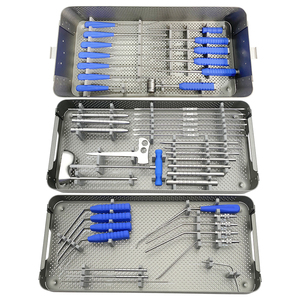
Private day-surgery clinics in major urban hubs perform dozens of phacoemulsification procedures daily. These facilities prioritize rapid instrument turnover, seamless sterilization compatibility, and ergonomic comfort to prevent hand fatigue. Our customized cataract surgery tray sets feature color-coded anodized titanium handles, enabling instant visual sorting by surgical nursing staff between rapid autoclave cycles.
2. University Hospitals & Tertiary Research Centers (Kyoto, Keio, Tohoku)
Japan's leading academic medical centers focus on complex cases—such as subluxated lenses, dense brunescent cataracts, and combined glaucoma-cataract procedures. Surgeons in these operating theaters demand specialized micro-forceps with integrated capsulorhexis calipers (e.g., 5.5 mm markers engraved directly on the jaws) to ensure exact optical zone centering for premium toric and multifocal IOLs.
3. Prefectural & Community Hospitals (Hokkaido, Shikoku, Kyushu)
Regional hospitals operating under strict municipal budgets seek maximum long-term return on investment (ROI). They rely on our high-durability SUS440C micro-needle holders and Barraquer speculums, which feature vacuum-nitride coatings to prevent joint wear, corrosion, and jaw slippage over thousands of surgical procedures.
Localized Market Trends & Regulatory Landscape in Japan
Navigating the Japanese medical device market requires navigating strict regulatory protocols overseen by the PMDA (Pharmaceuticals and Medical Devices Agency) and the MHLW (Ministry of Health, Labour and Welfare) under the Pharmaceutical Affairs Law (PAL). Successful market entry and long-term distribution depend on addressing several key regional trends:
- Compliance with JMDN (Japan Medical Device Nomenclature): Micro-surgical tools imported into Japan must map cleanly to designated JMDN code classifications. Rigor Instruments supplies complete technical master files, material batch certificates, and ISO 13485 audit data to streamline Japanese regulatory submissions for Class I and Class II medical device registrations.
- Eco-Friendly Hospital Initiatives (SDGs in Healthcare): In alignment with Japan's national commitment to Sustainable Development Goals (SDGs), Japanese healthcare institutions are increasingly favoring high-durability reusable micro-instruments over disposable plastic-heavy instruments to minimize medical hazardous waste generation.
- Rising Demand for Custom OEM & Private-Labeling: Japanese distributors frequently require custom laser marking—including Japanese kanji catalog numbers, QR tracking codes for UDI (Unique Device Identification), and custom brand logos. Our facility in Sialkot provides high-precision laser etching with zero disruption to surface passivations.
Q1: How does Rigor Instruments support Japanese PMDA regulatory filings?
+
We provide full technical documentation for Japanese medical device importers, including ISO 13485:2016 certificates, ISO 9001:2015 reports, CE Mark conformity declarations, raw material mill test certificates (ISO 7153-1 / ASTM F899), passivation compliance reports, and step-by-step manufacturing process flowcharts necessary for Foreign Medical Device Manufacturer Accreditation and PMDA Class I/II notifications.
Q2: What steel grades and surface treatments prevent corrosion during Japanese autoclave protocols?
+
We utilize top-tier German and Japanese stainless steel alloys (AISI 410, 420, 316L, SUS440C) alongside Grade-5 Titanium (Ti-6Al-4V). All instruments undergo ultrasonic cleaning, citric or nitric acid passivation according to ASTM F86 standards, and a matte anti-reflective plasma polish. This protects against pitting corrosion and water spot staining even under high-temperature steam sterilization (134°C for 18 minutes).
Q3: Can you manufacture custom micro-tip geometries according to a Japanese surgeon's blueprint?
+
Yes. Our OEM/ODM engineering department specializes in custom surgical tool fabrication. Importers can submit technical drawings, CAD files, or physical reference samples. We produce working prototypes with micro-tolerances down to ±0.01 mm, complete with custom handle balance, tip curvature, laser-engraved catalog numbers, and private-label packaging.
Q4: What is the typical lead time, shipping protocol, and MOQ for shipments to Japan?
+
Standard production lead times range from 3 to 5 weeks depending on order complexity and volume. For repeat distributor catalog items, we offer flexible low MOQs (Minimum Order Quantities starting at 10 to 25 units per item code). Fast air freight delivery is handled via DHL, FedEx, or specialized air cargo directly to Narita (NRT), Haneda (HND), or Kansai (KIX) airports with full export documentation.
Q5: How is micro-instrument tip alignment verified prior to dispatch?
+
Every single micro-instrument (including capsulorhexis forceps and micro-scissors) undergoes high-magnification optical comparator testing at 40x magnification. Quality control inspectors verify jaw closure alignment, force requirements, smooth hinge action without play, and zero burrs or sharp edges on atraumatic surfaces before final cleanroom sealing.
Partner with a Premier Cataract Surgical Instruments Manufacturer
Elevate your surgical instrument catalog in Japan with ISO 13485 certified micro-instruments. Request our comprehensive technical ophthalmic catalog and factory-direct B2B quotation today.