Discover the latest industry trends, regulatory guidelines, manufacturing standards, and clinical instrument guides from Rigor Instruments.
OEM & Quality Knowledge
Precision Manufacturing & Standards
In-depth guides on ISO certifications, surgical stainless steel grades, and custom tool engineering.
Global Healthcare Insights
Medical Export & Regulatory Guides
Stay informed about international health authority regulations, import standards, and clinic equipment requirements.
Top Trusted Major Surgery Instrument Sets Manufacturer & Exporter
Global Clinical Procurement Whitepaper & Strategic Technical Guide for Tier-1 Hospitals, Surgical Centers, and Authorized Medical Equipment Importers
Precision Portfolio
Featured Surgical Instrument Sets & Specialized Endoscopic Tools
Engineered from premium German and Japanese surgical stainless steel. Certified for extreme durability, repeated autoclave cycles, and micro-precision clinical performance.
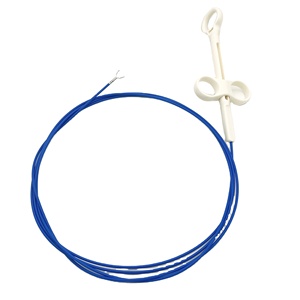
Gastroenterology Rotatable Disposable Endoscopic Hemoclip With Claw Angle 135
Executive Procurement Overview: Metallurgical & Engineering Standards in Major Surgical Instrumentation
In contemporary acute healthcare environments, the structural integrity, tactile feedback, and ergonomic precision of major surgery instrument sets directly govern operative outcomes and patient safety. As hospitals, ambulatory surgical centers (ASCs), and international medical procurement syndicates transition toward high-throughput operating rooms, the demand for autoclave-resilient, precision-machined surgical tools has expanded exponentially.
Surgical instrument manufacturing is anchored in chemical composition, heat treatment protocols, and mechanical surface passivation. For over four decades, our manufacturing facilities in Sialkot, Pakistan—the globally recognized epicentre of medical grade metalcraft—have pioneered hand-finished and CNC-milled surgical instrument sets utilizing premium German and Japanese stainless steel alloys.
Metallurgical Comparison: Medical Grade Alloys for Surgical Tooling
To provide technical clarity for hospital purchasing departments and QA auditors, the table below outlines the material specifications, Rockwell Hardness scales (HRC), and primary surgical applications of our core metallurgy portfolio:
Every instrument manufactured within our ISO 13485-certified ecosystem undergoes automated surface passivation according to ASTM A967 standards. Citric and nitric acid treatment baths remove free iron particles from the outer boundary layer, forming a self-healing Chromium Oxide (Cr₂O₃) passive skin. This eliminates micro-pitting, staining, and stress-corrosion cracking during repeated steam sterilization at 134°C (273°F).
Enterprise Advantage: 40+ Years of Manufacturing Excellence in Sialkot, Pakistan
Rigor Instruments stands as a preeminent second-generation surgical instruments manufacturer headquartered in Sialkot, Pakistan (Village Kotli Bhutta, Wazirabad Road). Sialkot controls over 70% of the worldwide global export volume for hand-crafted reusable surgical instruments. Our facility synthesizes traditional master forging craftsmanship with state-of-the-art 5-axis CNC machining, micro-laser welding, and automated dimensional optical verification.
Dual Quality Certifications
Full compliance with ISO 9001:2015 and ISO 13485:2016 Quality Management Systems. Our processes align with US FDA QSR (21 CFR Part 820) and European MDR 2017/745 regulatory directives.
Extensive 28-Specialty Portfolio
Over 5,000 distinct active catalog numbers spanning Neurosurgery, Orthopedics, ENT, Cardiovascular, Ophthalmic, Cosmetic Plastic Surgery, Minimal Invasive Laparoscopy, and Veterinary Endoscopy.
End-to-End OEM & Private Label
Turnkey original equipment manufacturing (OEM) and custom design manufacturing (ODM). We offer custom fiber-optic integration, unique laser-etched UDI markings, and custom sterile container packing.
Unlike intermediaries or trading companies, Rigor Instruments operates as a direct factory source. Purchasing officers and distributors eliminate markups, receive direct raw material mill test certificates (MTC), and gain direct access to our metallurgical engineers during product prototyping.
Specialized Major Surgery Sets: Technical Breakdown & Clinical Utility
Modern surgical procedures require standardized instrument trays structured for speed, ergonomics, and tissue preservation. Below is an analytical examination of four major specialized instrument configurations engineered by our technicians:
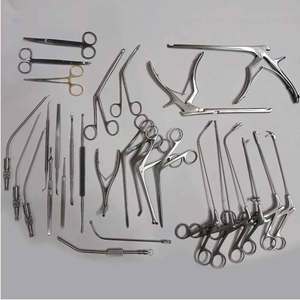
Designed for complex rhinological and paranasal sinus interventions, the FESS 30-Piece Tegra Instrument Set integrates ultra-fine, double-action through-cutting forceps, rotatable nasal punches, and curved suction cannulas. Forged from high-tensile German stainless steel, each jaw articulation is hand-honed to eliminate tissue tearing, minimizing intraoperative bleeding and mucosal trauma.
2. Unilateral Biportal Endoscopic (UBE) Spinal Surgery Sets
The emergence of UBE spinal surgery represents a paradigm shift in minimally invasive lumbar decompression and discectomy. Our UBE instrument kit includes specialized neural retractors, radiofrequency electrode channels, targeted Kerrison rongeurs, and diamond burr shields. Featuring non-reflective matte or black ceramic coatings, these tools prevent light scatter under high-definition endoscope illumination.
3. Plastic & Endoscopic Facelift Surgical Trays
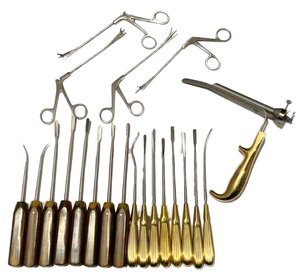
Facial aesthetic surgery demands microscopic precision and non-traumatic tissue elevation. Our cosmetic facelift sets incorporate specialized fiber-optic lighted retractors with integrated suction channels, endoscopic dissecting scissors, and subperiosteal elevators. The ergonomically balanced handles reduce hand fatigue during multi-hour rhytidectomy operations.
4. Gastroenterology & Endoscopic Hemoclip Systems
In gastrointestinal endoscopy, immediate post-polypectomy mucosal sealing and arterial bleed control require reliable mechanical clipping. Our rotatable 135-degree claw hemoclip devices deliver 360-degree continuous rotation, exceptional tactile feel, and high clamping force. Available in single-use sterile packaging, they meet the stringent infection prevention protocols of modern endoscopy units.
Future Sourcing & Procurement Trends in Major Surgical Instrument Manufacturing
The global market for general and specialized surgical instrument sets is undergoing a structural realignment. Supply chain directors and procurement executives are shifting away from transactional purchasing toward strategic long-term OEM manufacturing partnerships. Key trends shaping global hospital procurement between 2025 and 2030 include:
1. Smart Traceability & Micro-UDI Matrix
Regulatory agencies worldwide (US FDA GUDID, EU EUDAMED) now mandate Unique Device Identification (UDI). Future surgical sets will feature direct laser-etched 2D DataMatrix codes operating on micro-durability scales, enabling automated asset tracking and sterilizer cycle count logging.
2. Hybrid Reusable-Disposable Eco-Systems
Hospitals are optimizing total cost of ownership (TCO) by pairing heavy-duty reusable structural handles (such as titanium elevator frames) with single-use sterile micro-endoscopic tips and hemoclips to lower cross-contamination risk while managing capital expenditures.
3. Advanced Surface Coatings (DLC & TiN)
Diamond-Like Carbon (DLC) and Titanium Nitride (TiN) physical vapor deposition (PVD) coatings are expanding. DLC coatings increase surface hardness beyond 85 HRC, drastically reducing friction on moving joints and eliminating optical reflection under intense surgical lights.
4. Sustainable & Circular Metallurgy
Environmental, Social, and Governance (ESG) criteria are moving to the forefront. Leading exporters must implement zero-wastewater electro-polishing systems and closed-loop stainless steel recycling to satisfy green hospital procurement guidelines in North America and Western Europe.
Quality Control Workflow: From Raw Forging to Autoclave Validation
To ensure every surgical tool set delivered by Rigor Instruments performs flawlessly under surgical conditions, our Sialkot manufacturing plant operates a stringent 7-stage quality assurance (QA) gateway:
QA Gateway Stage
Inspection Protocol
Technical Pass Criteria
Stage 1: Raw Material Audit
Spectrographic chemical analysis of imported steel billings
Verification of Carbon, Chromium, Nickel, & Molybdenum % ratios to DIN standards
Stage 2: Precision Forging
Drop-forge mold inspection and grain flow alignment check
Zero structural voids, micro-fractures, or density inconsistencies
No pitting, discoloration, or alignment drift post 50-cycle autoclave stress test
Frequently Asked Questions (FAQ) for Healthcare Procurement Officers
Q1
Why is Sialkot, Pakistan recognized as the premiere global hub for surgical instrument manufacturing?
Sialkot possesses over a century of specialized metallurgical craftsmanship combined with modern medical engineering infrastructure. Controlling over 70% of global hand-held surgical instrument exports, Sialkot’s manufacturing ecosystem offers unmatched cost efficiencies, skilled hand-finishing artisans, and strict compliance with international standards such as ISO 13485 and CE marking.
Q2
What steel grades are used in Rigor Instruments’ major surgery sets, and how are they verified?
We exclusively forge instruments using certified German (DIN) and Japanese (JIS) stainless steel alloys, predominantly AISI 420A, 420B, 420C, and 440C grades. Every raw material lot is accompanied by Mill Test Certificates (MTC) and undergoes batch spectrographic testing to guarantee precise chromium-carbon ratios prior to production.
Q3
Can Rigor Instruments fulfill OEM custom private labeling and laser etching requests?
Yes. We specialize in OEM and ODM manufacturing for global medical device brands and hospital networks. We provide high-precision fiber-laser marking for custom brand logos, specific SKU catalog numbers, lot identification codes, and UDI-compliant 2D DataMatrix barcodes. Custom packaging and sterile wrap configurations are also supported.
Q4
What quality certifications and export documentation accompany your shipments?
Our factory operates under ISO 9001:2015 and ISO 13485:2016 quality management systems. All surgical instruments carry CE marking under European Medical Device Regulations (MDR) and are FDA listed for US market distribution. Export documentation includes Certificates of Origin (COO), Passivation Certificates, Sterilization Compatibility Reports, and Commercial Invoices.
Q5
How do your instruments handle repetitive high-temperature steam sterilization (Autoclaving)?
Our instruments undergo chemical passivation per ASTM A967, forming a protective chromium oxide layer that prevents oxidation, rust, and pitting. They are engineered to endure thousands of standard steam autoclave cycles (134°C / 273°F at 2.1 bar pressure) without joint stiffness, tension loss, or surface degradation.
Q6
What is the typical lead time for bulk wholesale and custom surgical instrument set orders?
Standard catalog items in moderate bulk quantities typically ship within 2 to 4 weeks. Custom OEM sets or newly prototyped instruments require 4 to 6 weeks, allowing time for forging die setup, CNC programming, hand adjustments, and rigorous QA verification before air or sea freight dispatch.
Partner with a Premier Surgical Instrument Manufacturer
Upgrade your healthcare facility's surgical inventory or expand your medical distribution portfolio with factory-direct pricing, certified German/Japanese steel craftsmanship, and complete OEM customization.