Technical and commercial answers to frequently asked questions from medical equipment buyers, hospital procurement officers, and international importers:
Q1: What is the main functional difference between Bipolar and Monopolar Forceps?
In monopolar forceps, high-frequency electrical current flows from a single active electrode (the forceps tip) through the patient's body to a grounding patient return pad. In bipolar forceps, the current flows only between the two tines of the forceps tip, creating a localized circuit. Bipolar forceps require significantly lower voltage, eliminate the need for a return pad, and substantially minimize peripheral thermal damage, making them far safer for delicate procedures such as neurosurgery, ophthalmic surgery, and vascular procedures.
Q2: How do non-stick bipolar forceps prevent tissue charring and adhesion?
Non-stick bipolar forceps utilize tips fabricated from high thermal conductivity materials, such as solid silver alloys or specialized gold-plated substrates. Because silver conducts heat away from the surgical point vastly faster than standard stainless steel, the working tip temperature remains below the threshold where eschar and desiccation adhere to the metal. This allows continuous coagulation without requiring frequent intraoperative tip scraping.
Q3: How many autoclave sterilization cycles can Rigor Instruments' reusable forceps withstand?
Rigor Instruments manufactures reusable bipolar and monopolar forceps using high-grade dielectric insulation coatings (PTFE and specialized polymer resins) capable of enduring 200 to 300 standard steam sterilization cycles (134°C / 273°F at 2.1 bar) without cracking, peeling, or electrical leakage, provided proper cleaning and enzymatic decontamination protocols are followed.
Q4: Are your electrosurgical forceps compatible with major generator platforms (Erbe, ValleyLab, Olympus)?
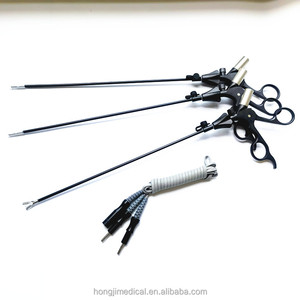
Yes. Our electrosurgical forceps are manufactured with standardized European (2-pin 28.5mm pitch) and US (flying lead or 2-pin) connector interfaces. We offer universal adaptors and custom-molded cables compatible with all international high-frequency electrosurgical generators, including Erbe, Covidien/ValleyLab, Bovie, KLS Martin, and Olympus units.
Q5: What quality control tests are conducted prior to product export?
Every electrosurgical instrument undergoes a comprehensive multi-stage inspection process: 1) Spectrographic raw material validation for German/Japanese steel composition; 2) Microscopic jaw alignment testing for precise tip apposition; 3) Dielectric breakdown testing at high peak voltages (up to 3,000V AC) to ensure insulation safety; 4) Autoclave heat-resistance stress testing; and 5) Visual surface polish examination under magnification.
Q6: Can Rigor Instruments manufacture custom tip shapes or length specifications for OEM orders?
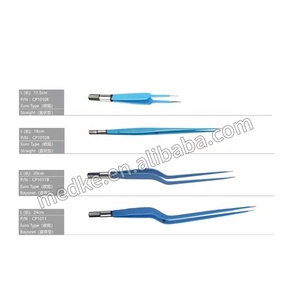
Absolutely. As a direct manufacturer, we offer full OEM/ODM customization. Clients can provide engineering technical drawings, CAD files, or physical reference samples. We can adjust tine lengths (from 11 cm to 30 cm), tip sizes (0.2 mm micro-tips to 2.0 mm heavy coagulation tips), jaw curvature (straight, angled 45°, curved), and insulation color specifications.
Q7: What is the typical Minimum Order Quantity (MOQ) and lead time for wholesale export orders?
Our standard MOQ for wholesale electrosurgical forceps is highly flexible, starting at just 20 to 50 units per catalog number for established distributors. Typical lead time for standard catalog items is 2 to 3 weeks, while custom OEM branding or bespoke private label production usually requires 4 to 6 weeks depending on volume and packaging requirements.
Q8: What documentation is provided for medical device regulatory clearance in foreign customs?
We provide full export documentation packages, including Certificates of Conformance (CoC), ISO 9001 and ISO 13485 certificates, CE Declarations of Conformity, Certificates of Free Sale (CFS), material test certificates, and sanitized commercial documentation required by customs authorities across the EU, Middle East, Americas, and Asia-Pacific regions.